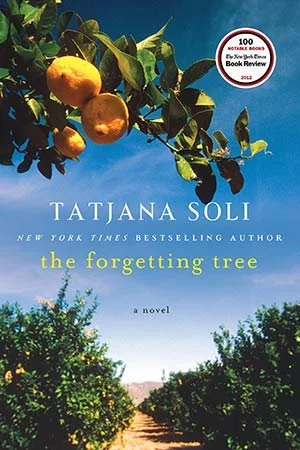
“Daring… haunting… The lesson Soli has to teach… is a salient one for the modern world: even a remote citrus ranch can be a crossroads where cultures collide, and those collisions can be life-changing for everyone involved. Soli writes with patience and wisdom about both sides of this relationship, allowing both of her central female characters the freedom to be eccentric and inconsistent, but also to learn from each other.”
—NEW YORK TIMES BOOK REVIEW, JANE SMILEY
Order:
Amazon | Barnes & Noble | IndieBound
When Claire Nagy marries Forster Baumsarg, the only son of prominent California citrus ranchers, she knows she’s consenting to a life of hard work, long days, and worry-fraught nights. But her love for Forster is so strong, she turns away from her literary education and embraces the life of the ranch, succumbing to its intoxicating rhythms and bounty until her love of the land becomes a part of her. Not even the tragic, senseless death of her son Joshua at kidnappers’ hands, her alienation from her two daughters, or the dissolution of her once-devoted marriage can pull her from the ranch she’s devoted her life to preserving.
But despite having survived the most terrible of tragedies, Claire is about to face her greatest struggle: An illness that threatens not only to rip her from her land but take her very life. And she’s chosen a caregiver, the enigmatic Caribbean-born Minna, who may just be the darkest force of all.
Haunting, tough, triumphant, and profound, The Forgetting Tree explores the intimate ties we have to one another, the deepest fears we keep to ourselves, and the calling of the land that ties every one of us together.
Reviews
“Daring… haunting… The lesson Soli has to teach… is a salient one for the modern world: even a remote citrus ranch can be a crossroads where cultures collide, and those collisions can be life-changing for everyone involved. Soli writes with patience and wisdom about both sides of this relationship, allowing both of her central female characters the freedom to be eccentric and inconsistent, but also to learn from each other.”
—NEW YORK TIMES BOOK REVIEW, JANE SMILEY
“A lush novel with two fascinating, complicated characters at its heart.”
—BOOKLIST
“When the themes of a novel are so clearly a certain set of the Big Ones (family, loss, illness, forgiveness, and the like), it can run the risk of falling into saccharine Hallmark territory. To keep a story like this vital and compelling, rather than merely appealing to those more manipulative of our emotions, the characters must stay pinned to a believable reality, with a touch of darkness. Soli does just that. The book centers around Claire Baumsarg and her family, who run a California citrus farm that feels right out of Roman Polanski’s Chinatown, where the land is unforgiving, irrigation is paramount, and evil lurks in the recesses of the mundane. It’s a hard life to begin with, even before a series of trials are visited upon them. The first, a tragic and violent death, hits the family like a comet, and the second, an illness that strikes Claire years later when her familial circumstances have changed, tests the ability of both her body and her spirit to endure. The story here is complex and expansive, and Soli’s prose is reminiscent of Eudora Welty’s. Like that writer, Soli’s sentences are tied to the land, and the effect is that as much as this is a story about people, it is also a story about place and the imprint that each makes on the other.”
—HOT READS AT THE DAILY BEAST
“Soli has again created characters readers will love and care about. She does so with deceptively simple grace: Their yearnings breeze right into your life. And while the book is more cerebral than visceral, Claire’s future and Minna’s past are questions that keep the pages turning. The Forgetting Tree is a journey worth taking.”
—BOOK PAGE
“A lush, haunting novel for readers who appreciate ambiguity, this work should establish Soli as a novelist with depth and broad scope.”—LIBRARY JOURNAL
“Will captivate readers… with this twisting, intriguing tale of a grieving California woman. Beautiful prose and striking detail.”—PUBLISHERS WEEKLY
“Tatjana Soli’s new novel is rich in both style and substance. Beautifully written, sensuous, and profound, The Forgetting Tree is a book about relationships, including the relationships you have with yourself and with your surroundings.”
—SUKO’S NOTEBOOK
“The narrative at times feels allegorical, submerging her reader into a dreamlike realm where reason comes second to matters of the heart.”
—FICTION WRITERS REVIEW
“This novel has it all—mystery, psychological insight, emotional truth, and—most important—characters whose lives matter. You’ll fall in love with these families. Soli writes with such passion it is inescapable, lyrical, and profoundly moving. The Forgetting Tree goes on my top ten list.”
—JONIS AGEE, AUTHOR OF THE RIVER WIFE
“Like her protagonist Claire who literally tastes the earth to predict the season’s crops, Tatjana Soli delves deep into the soil of two magnetic and powerful female psyches to produce a novel that is lush, evocative, and hypnotic. An incredible book, richly imagined and beautifully written.”
—NANCY ZAFRIS, SERIES EDITOR, THE FLANNERY O’CONNOR AWARD FOR SHORT FICTION
“Tatjana Soli’s elegant and sensuous prose will keep you spellbound. The Forgetting Tree is an earthy book, full of beautiful surprises.”
—MARIA SEMPLE, AUTHOR OF WHERE’D YOU GO, BERNADETTE
“The Forgetting Tree is a captivating, dreamlike story about the power of family ties… A lushly poetic, deeply authentic novel that surprises at every turn.”—KAT BAILEY, BOOKSHOP SANTA CRUZ
“It has been a long time since a book so drew me in and made me think as much as The Forgetting Tree by Tatjana Soli. It is a superb book, rich in imagery and delightful to read…This book will be a book club’s paradise.“
—LUXURY READING
“Soli’s writing shines in The Forgetting Tree, and Claire is a strong, nuanced, memorable woman. This novel, although shadowed by grief, is surprisingly hopeful.”
—NOMADREADER
“Tatjana Soli brought her characters to life, beyond the words upon the page, reaching into my heart and leaving a lingering trace upon my mind I shall not forget.“
—MY BOOKSHELF
“The story left me in a thoughtful place for several days after I finished it… The Forgetting Tree moved me and was another reminder of why I love reading so much.“
—MUSINGS OF A BOOKISH KITTY
“In the end, this is a masterful, deeply symbolic story of loss and connection and belonging.“
—BOOKNAROUND
Behind the Scenes
~ HOME ~
“Claire would be loyal to that mystery to the end of her days,
because it was identical to the mystery of life, which one loved
without ever fully comprehending it.”
Our first house in Southern California was on top of a hill with a view below of orange and avocado groves stretching out in rows as far as the eye could see. In the spring, the air was perfumed with citrus blossoms, and at roadside stands you could pick up large bags of oranges and lemons for a dollar. I loved it and took it for granted that it would always be that way.
A few years later, on our evening hike through eucalyptus groves, we came across a fleet of parked tractors. Plans were underway to tear down trees to make a road. Five years later there was a four-lane highway where the grove had been; five years after that there were gated housing developments as far as the eye could see. Now the only smell of orange blossoms comes from our potted trees in the garden. It was my first experience of the transience of place. Although I disliked what was happening, I was relatively a newcomer. I wondered how the people who had lived here for generations, who had made their living from farming, felt about the changes. Most of my ideas for books start with place, but this one also started with a character, Claire, a ranching woman, who would not accept the transience of place.
Place was also integral in connection to another of the major issues I wanted to explore in the book — the clash of different cultures. I wanted to explore the issues of power/powerlessness and needed a catalyst. One of my favorite novels is Wide Sargasso Sea by Jean Rhys. In college I remember my writing professor recommending it to me, saying, “It will change you.” That’s a pretty irresistible recommendation, isn’t it? One of the overwhelming things in the book for an English major is the discovery that the madwomen in the attic from Jane Eyre is actually a living, breathing human being with her own side of the story to tell. It makes it very hard to ever return to Jane Eyre and see that story in the same light. The idea of a character others make false assumptions about intrigued me and became the seed for the character of Minna. She allowed me to explore questions such as when do we finally belong to a culture, to a family? Do we have to forget our past selves? When can we finally call a place home?
Recommended Books
Jane Eyre, by Charlotte Bronte — Yes, it’s a classic, but it’s so much fun to reread. It was considered ahead of it time in its exploration of a strong female character’s feelings, a proto-feminist text. Plus, you need it fresh in your mind as you learn about the madwoman in the attic, Bertha Antoinetta Mason, for the next book.
Wide Sargasso Sea, by Jean Rhys — My college professor said reading this book will change you, and I agree. The imagery and prose are stunning in their own right, but it is in the telling of an alternate history of the above that the novel really gains its power. Our assumptions and prejudices of the infamous madwoman are turned on their head. It is considered a post-colonial novel in that it tells the story of those whose voice is usually silenced. It deals with racial inequality and displacement. The relationship between the two texts inspired much of the structure of my book.
Housekeeping, by Marilynne Robinson — This is one of my favorite novels of all time. I’ll admit that I took a long time coming to it; the plot description of two young girls growing up in a small town in northern Idaho doesn’t begin to hint of how beautiful and profound the writing is. Hiding in the trappings of a domestic novel is a deeply subversive story about the freedoms to be found in nature and in throwing out society’s expectations. Ruth and Sylvie will haunt you long after the book is closed.
The Dew Breaker, by Edwidge Danticat — Danticat is an exquisite writer. The book is a series of linked short stories. The title comes from the Creole nickname for torturer, in this case referring to the Tonton Macoutes of the Duvalier regimes. Danticat was born in Haiti, and although she has lived in America most of her life, she writes about Haiti’s history with beauty and thoughtfulness.
The Rainy Season, by Amy Wilentz — This is my only non-fiction book on the list, but it is a fascinating look at Haiti after the “Baby Doc” Duvalier regime and the rise of Aristide. The added bonus (especially for readers of my last book, The Lotus Eaters) is that Wilentz is a female journalist navigating a dangerous and tumultuous country, and her vivid writing brings the experience alive for us.